Never News: feeling salty
Hello one and all! It's me, Producer Georgia, here with the newsletter you crave. But firstly...HAVE YOU BOUGHT A SHIRT?! You should!
And now, onto the news that's been plaguing my dreams this week:
THE CUT: on the Maldon Salt scandal and food-as-status
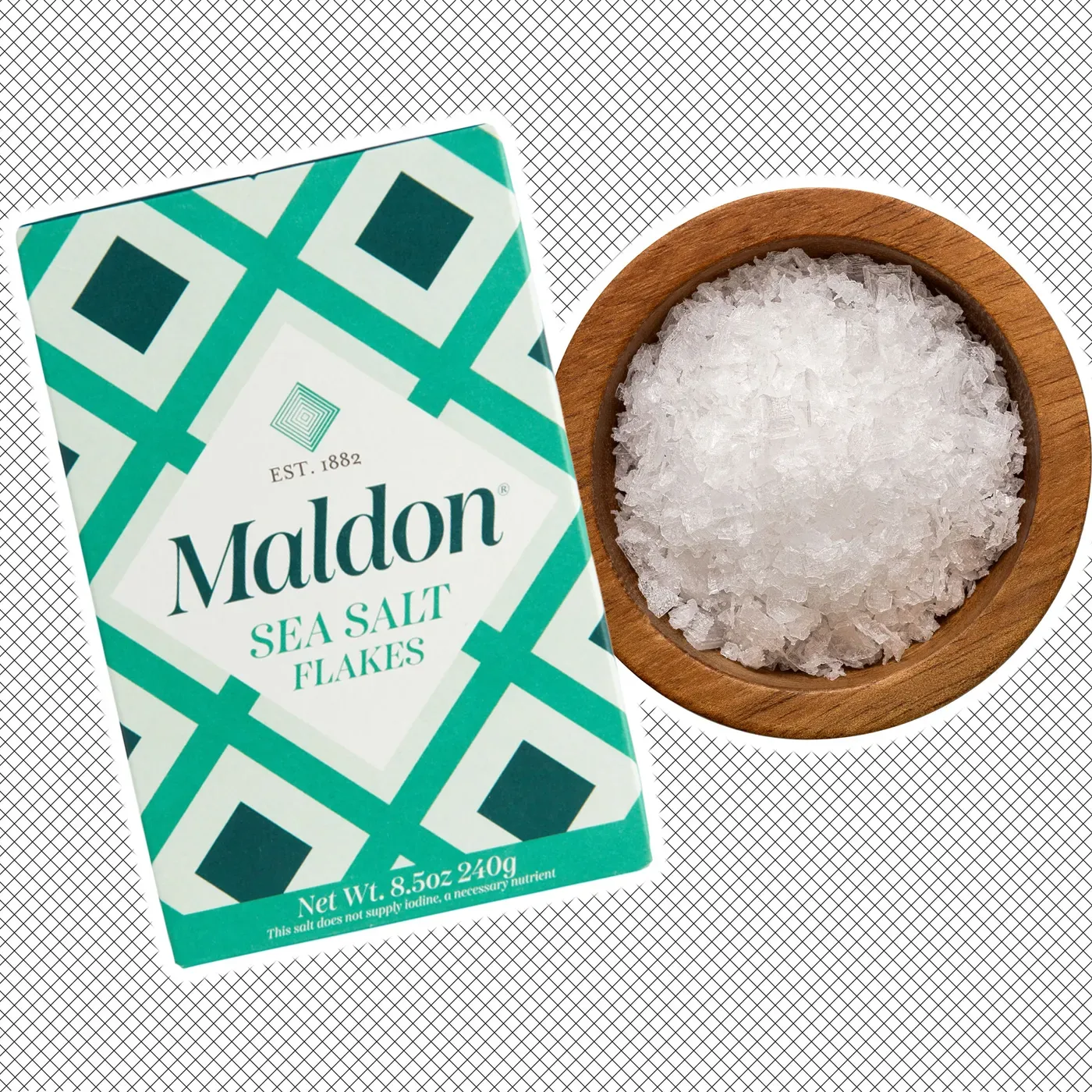
This is one of the quicker turnarounds I've seen of TikTok-first reporting that then explodes into a broader online freakout. This time, the discourse revolves around Maldon, a UK-based salt company that has become the darling of gourmands the world over. Their brand of pyramid-shaped finishing salt – simply named "sea salt flakes" and whose ingredients only list, you guessed it, "sea salt flakes" – has been decried as the best of the best by all the internet-forward food people you'd expect. I own a box of Maldon salt, and it honestly is great for finishing – it crunches and it's salty and I like it. But now, according to a report in The Observer published on TikTok, the brand's claim that these salt flakes aren't all what they seem. The actual truth of this has to do with its salt-making process – turns out they mix their saltwater with German rock salt in order to yield more product. So, not exactly the purist daydream of pulling salt straight from the seawater itself and turning it into those beautiful little salt pyramids . This doesn't technically make their single ingredient list wrong – rocksalt is still sea salt – but that's not the real problem here. The problem is one of cultural clout, and of expecting Maldon to fill the role that its packaging would suggest; packaging that, as this article points out, "looks right at home on a West Village kitchen countertop alongside a Graza bottle." Chekhov's Graza bottle, everybody.
And like Graza, Maldon is one of the pantry staples that is meant to bely a broader cultural authority, and one that is fostered through the social internet. It's a little more expensive than you'd want to spend on salt, certainly finishing salt - something I don't even use 90% of the time because I forget. And, like Graza, Maldon's self-presentation as a chic, elevated version of itself has faltered. But I don't really know if this will meaningfully affect Maldon. I certainly don't expect the discourse around this to last. Give this a week – hell, maybe less – and nobody will care about this. The "cutesy green-diamond packaging" still looks good on the shelf, and that seems sufficient.

THE NEW YORK TIMES: brainstacking and job-rot and girl what the hell are we even doing AHHHHHH
Hark, everyone! There is a new concept for all of us to learn. That concept is "brain stacking" and I fear I am going to be a hater about it. The idea behind it really isn't a bad one – to fend off a life full to the brim with screens and social media and scrolling, some influencers have decided to fight that with mindfully planned out non-screen activities. 15 minutes of reading, a page's worth of journaling, then doing a single sudoku. Stuff like that. And as this piece in NYT would show, there is scientific research available to back up the benefits of doing this. Namely, that setting up a habitual practice can be good for you. Totally! But now...I am going to be mean.
This is literally just having hobbies, but dulling it down to its most social media-friendly version. Which is to say, the performance of hobbies. Watch any of these videos and you'll see what I mean. There's a reason that these influencers will present their brain stack as a literal stack of things – it's the same thing that BookTok people do with all the books they read in October. It's the same thing as people rating all the soups at Trader Joes and showing them all in a gigantic, teetering tower of soups. It looks interesting, impressive. The eye goes "ah, a visual list of the things we are going to deal with." But a true, screen-free break this is not, by virtue of the fact that much time has also been spent recording, editing, and publishing the videos talking about it.
This reminds me of a video shared among the NP folks a while ago about a woman who went viral for chaining her smart phone to the wall, ostensibly to keep herself from looking at her phone all the time. But, as we were all quick to point out, she was still posting this. She was still using another phone – or another video camera – to film herself thoughtfully sitting down and scrolling through her phone, putting it down, then walking away. The chain itself seemed to be a chain belt just loosely hooked to a command hook on the wall??? And at that point I felt like I was going insane. It just feels so obviously performative that I worry any real merit in boundary setting our technology may be lost. It does make me wonder if there really is a way to talk online about a tech detox without it becoming exactly this. So far, I'm not sure.

THE CUT (again): the moralization of shopping
Sorry for the double-up on NY Mag, but they were really on one this week. This article poses a truly flummoxing question: can rebranding the mindful practice of shopping small/shopping local/shopping secondhand as "shoptimism" somehow...save us from a miserable world where so much is uncertain? I will bravely declare that the answer to that is, resoundingly, no. But I think this is an interesting pitfall that shows up a lot when we talk about shopping.
The idea of shopping small is a good thing; the same is true for buying secondhand. And it is especially important to buy secondhand when the fashion industry remains committed to selling you a $150 sweater that is made completely out of plastic – you can find a 100% cotton sweater at the thrift for $6. I will also say that this piece is right to point to that idea as a welcome alternative to the convenience-driven dopamine hit of TikTok Shop, Amazon, and the like. It does feel good to have to spend more serious time thinking about what you actually want or what your style even is, rather than choosing from an endless Rolodex of stuff. Sometimes, I go to the thrift store after staring at my computer for too long, just to have to spend an hour or two touching a bunch of physical stuff and methodically going through the racks. If I find something fun, that's a bonus.
Where I begin to feel weird and gross is when we stop the conversation at the act of purchasing. There is so much more worth saying about why thrifting as the only viable choice for a lot of people. It is not good that we are surrounded by $150 polyester sweaters, to say nothing of the economic situation many of us are experiencing where buying a $6 sweater – cotton or otherwise – is the only option. The online resale market is rife with the kind of optimization this article claims to be nonexistent in the world of thrifting. Often, that $6 cotton sweater at the thrift becomes a $45 cotton sweater on Depop. And if you don't know that there should be a big price difference there, then you're likely to pay up.
This piece makes a point to distance itself from the "I deserve a little treat" culture that encourages all kinds of foolish shopping, but I really don't see a difference here if we are still only thinking about the feeling of buying something. We've talked enough about how good it feels to buy the brand of tea you used to have as a kid. By all means, buy it. Comfort yourself! But when it comes to shopping discourse, I think we need to grow up.
Alright folks, that's all from me. I'll catch you on the post-Thanksgiving flip, and until then I wish you a drama-free holiday. Or at least one that passes quickly.
Smoochies! P.G.